Automate Payment Reconciliation Without Switching Processors


Processor migrations affect contracts, integrations, reporting, and customer-facing payment workflows.
Companies often put a migration on the roadmap because finance cannot reconcile payments without downloading reports, rebuilding settlement batches, and tracing discrepancies across systems.
When the current provider exposes usable transaction and settlement data, a reconciliation platform can connect it with bank activity, internal records, and the general ledger while the processor keeps moving money.
This guide explains how that model works, what information the automation requires, which tasks can be handled reliably, and when the current processor may still become the constraint.
Table of Contents
How Automated Payment Reconciliation Works Around an Existing Processor
Automated payment reconciliation collects processor, bank, internal, and ledger records; normalizes their formats and statuses; matches related activity; and routes discrepancies for review. The processor continues authorizing, capturing, and settling payments.
The processor records authorizations, captures, refunds, fees, disputes, payouts, and settlements. The reconciliation layer compares those records with the original obligation, bank deposit, and accounting treatment.
That business context usually lives elsewhere.
For property management, that may mean connecting rent with the resident balance, property ledger, trust account, owner obligation, bank deposit, and accounting entry.
For insurance, it may mean connecting a premium with the policy, billing schedule, producer allocation, carrier record, settlement, and general ledger.
The division of responsibilities can be summarized as follows:
PAYMENT PROCESSOR | RECONCILIATION LAYER |
Authorizes and captures payments | Connects payment records across systems |
Calculates processing activity and fees | Compares expected amounts with actual activity |
Creates refunds and dispute records | Traces how those events affect other records |
Groups transactions into settlements | Reconstructs the gross-to-net settlement |
Sends funds to designated accounts | Confirms what reached the bank and ledger |
Reports processor-side statuses | Flags discrepancies and preserves resolutions |
Five Records the Reconciliation Layer Must Connect
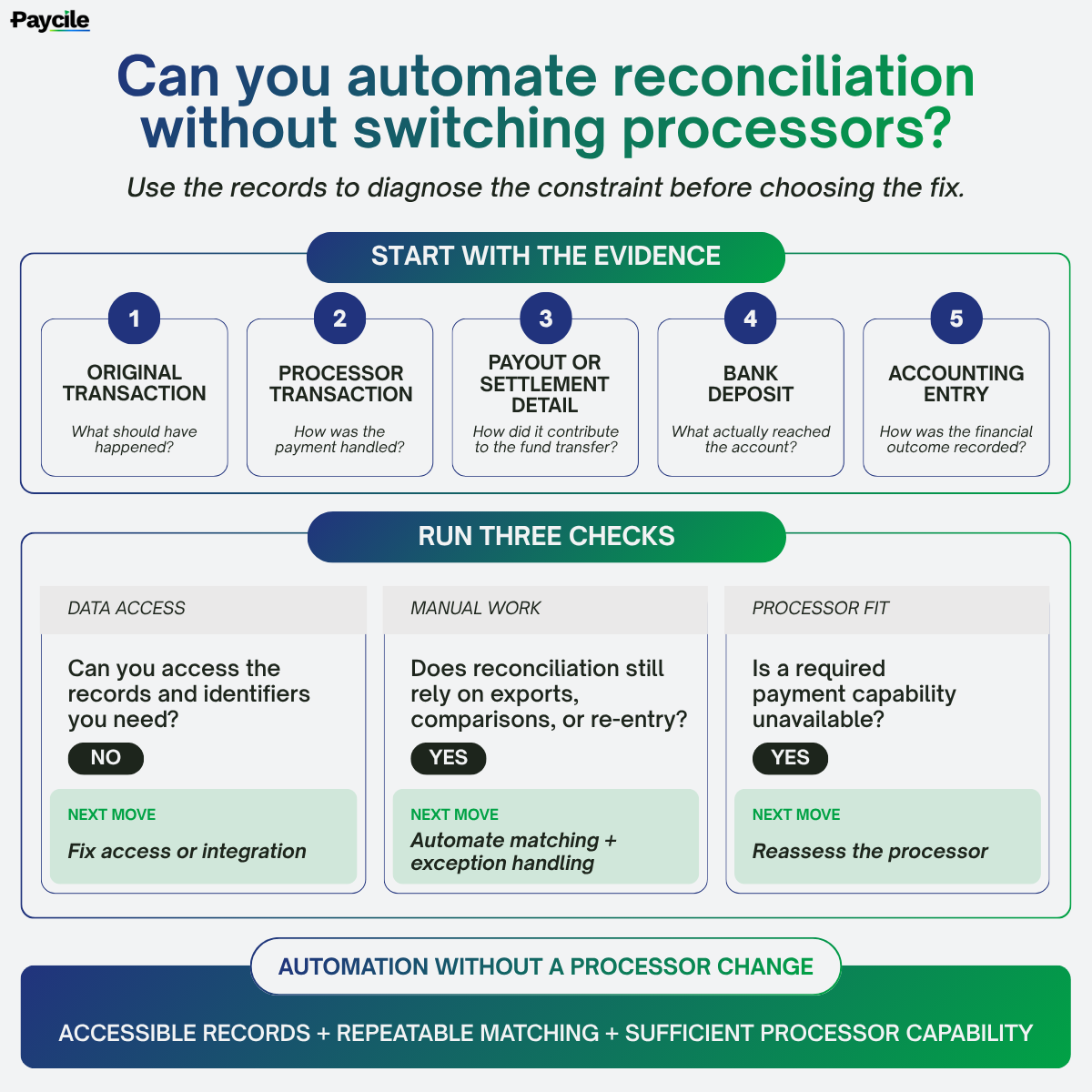
The workflow connects five records, each answering a different financial question:
- Original transaction — What should have happened?
The payment, invoice, policy, resident balance, or order establishes the amount, customer, obligation, and business context.
- Processor transaction — How was the payment handled?
This records authorization, capture, status, payment method, and any refund, return, or dispute.
- Payout or settlement detail — How did the transaction contribute to the fund transfer?
This shows the payments, fees, refunds, and adjustments included in the settlement amount.
- Bank deposit — What actually reached the account?
This confirms the deposited amount, posting date, and destination account.
- Accounting entry — How was the financial outcome recorded?
This shows how the payment, fees, liabilities, revenue, and adjustments were recorded in the ledger.
Embedded payments reconciliation keeps those versions of the transaction aligned without requiring one system to replace every other system involved.
The Data Automation Needs From Your Current Stack
Payment processor reconciliation depends on whether the necessary records are detailed, consistent, and retrievable. An existing processor can remain when data is available through an API, webhook, scheduled report, secure file transfer, or structured export. The method matters less than whether the records arrive with enough context for reliable matching.
Transaction-Level Processor Records
The reconciliation layer needs more than daily sales totals. Each processor record should provide enough information to identify the transaction and understand its current state.
Useful fields include:
- Transaction and customer references
- Gross amount and currency
- Authorization and capture timestamps
- Payment method
- Processing status
- Refunds and reversals
- Chargebacks and returns
- Processor fees
- Related or original transaction IDs
Transaction-level detail matters most after a payment changes. A refund may settle separately, a chargeback may affect a later payout, and an ACH return may reverse funds after internal application. Each event must stay connected to the original transaction and the downstream records it changes.
Payout and Settlement Details
A $9,720 deposit cannot be reconciled to $10,000 in gross payments until finance explains the $280 difference, including fees, refunds, reserves, disputes, adjustments, or timing shifts.
The settlement record should show which transactions and deductions produced the net deposit. Otherwise, the bank total may be right while fees, revenue, liabilities, or customer balances remain wrong.
This becomes even more important in split payment reconciliation, where one payment may create several allocations, recipients, and ledger outcomes.
Bank and Internal System Records
Processor data shows what the provider recorded, bank activity confirms whether funds reached the correct account, and the internal system supplies the business obligation.
That obligation may be an invoice, policy, resident balance, merchant account, distribution, commission, reserve, or liability.
Comparing these independent records creates the foundation for three-way reconciliation. It prevents one incomplete record set from becoming the only source used to validate the transaction.
Stable Identifiers and Matching Rules
Automation needs reliable links between records. Exact transaction IDs are strongest; otherwise, controlled combinations of amount, date, customer, account, reference, settlement window, and transaction type may be required.
Matching must also preserve context so one property, policy, merchant, or legal entity cannot be confused with another.
Strong matching logic begins with strong control design, and the best way to modernize ERP internal controls is to build governance into the implementation from the beginning.
Reconciliation follows the same principle. Rules, permissions, approvals, and evidence requirements should be defined before automated decisions begin affecting the books.

What Can Be Automated Without Moving the Payment Rails
Payment reconciliation automation can normalize data, match routine activity, reconstruct settlements, route exceptions, and preserve audit evidence. Human review remains necessary for incomplete, conflicting, unusual, or material records.
Collecting and Normalizing Data
Systems label timestamps and transaction states differently. A payment may appear paid internally, captured by the processor, pending settlement, and absent from the bank until the deposit posts.
Normalization turns those records into one financial lifecycle so teams can see what is complete and what is not.
Matching Transactions and Settlements
Routine records can be matched through configurable rules.
Advanced bank reconciliation matching rules can run in sequence as soon as statement data is imported, while selected cases can still require manual matching. Intelligent transaction matching for bank data follows a similar pattern by applying system rules to imported bank lines.
A broader reconciliation workflow can extend that logic across processor, platform, settlement, bank, and ledger records.
It may handle:
- One payment matched with one transaction
- Several transactions grouped into one payout
- One payment applied across several obligations
- Fees deducted before settlement
- Refunds netted against later activity
- Timing differences within defined tolerances
A balanced total does not prove the correct transactions were included. The rule must explain the match.
Detecting and Routing Exceptions
Automation can identify records that fall outside the expected sequence, including:
- Missing or delayed deposits
- Duplicate payments
- Unexpected processor fees
- Unapplied cash
- Incorrect settlement amounts
- Refunds without corresponding balance changes
- Transactions missing from a payout
- Ledger entries without supporting payment activity
Exceptions can be categorized, assigned, aged, and tracked, letting employees focus on the smaller set of records that require judgment.
Preserving the Financial History
A reliable process should record which rule created a match, which employee reviewed an exception, what evidence supported an adjustment, and when the final resolution occurred.
High-confidence matches can clear automatically, while incomplete, conflicting, unusual, or material records remain visible for approval. Strong payment reconciliation software reduces routine work without hiding ambiguity.
When the Processor Becomes the Constraint
A payment processor becomes the constraint when it cannot provide the transaction detail, settlement composition, identifiers, access methods, or payment capabilities the reconciliation workflow requires. Changing the integration or processor may then be necessary.
A processor change may deserve consideration when:
- Transaction-level records or settlement components are unavailable
- Fees, adjustments, or transaction-to-payout references are missing
- Data arrives too late, is inconsistent, or requires extensive repair
- Integration permissions prevent automated retrieval
- Historical records cannot be accessed when exceptions occur
The processor may also be the right target when the problem involves money movement, including settlement speed, payment methods, costs, account routing, merchant structures, underwriting, or risk.
A slow close alone does not prove the processor is failing. Identify the specific record or capability causing the delay.
CURRENT CONSTRAINT | LIKELY RESPONSE |
Records are accessible but compared manually | Add reconciliation automation |
Matching rules cannot handle payment complexity | Strengthen the reconciliation layer |
Exceptions lack ownership and evidence | Improve workflows and controls |
Processor data is incomplete or inaccessible | Change the integration or evaluate another processor |
Settlement or payment capabilities are inadequate | Reassess the processing relationship |

How to Assess Your Current Processor Before Automating Reconciliation
Start with one transaction that tested the operation. A refund, chargeback, partial settlement, missing deposit, fee correction, or failed allocation will reveal more than a standard payment.
This diagnostic also supports a broader assessment of embedded payments maturity.
- Trace the Full Transaction
Follow the payment through processing, settlement, banking, accounting, and resolution. Record every system, report, spreadsheet, and owner involved.
- Inventory the Available Data
Confirm which processor fields are retrievable and when they become available. Repeat for bank, operational, and accounting records.
- Test the Record Connections
Test whether persistent identifiers connect the transaction, payout, deposit, and ledger. If no exact ID exists, test a controlled combination of fields.
- Document the Rules
Define expected timing, fee treatment, settlement composition, account mappings, tolerances, allocation logic, and reversal handling.
Rules stored only in employee knowledge or private spreadsheets cannot support dependable automation.
- Define Human Review
Assign exception ownership across finance, operations, support, product, and compliance. Set approval thresholds and escalation timelines.
- Pilot the Difficult Cases
Pilot clean payments alongside refunds, returns, partial payments, disputes, delayed settlements, fee changes, and allocation errors. Testing only clean transactions overstates readiness.
- Measure the Operational Result
Useful measures include:
- Automatic match coverage
- Manual touches per transaction
- Exception volume and age
- Average resolution time
- Unexplained settlement differences
- Close duration
- Audit-trail completeness
The goal is the highest level of automation the available evidence can support.
Frequently Asked Questions
Can Payment Reconciliation Be Automated Without Direct API Access?
Yes. Scheduled reports, secure file transfers, bank feeds, or structured exports may support automation without an API. The files must be complete, consistent, and predictably available, although limited access may reduce reconciliation frequency.
Can One Platform Reconcile Multiple Payment Processors?
Yes. A platform can normalize multiple processors when each supplies sufficient transaction and settlement data. It should preserve differences in statuses, fees, payout timing, and record structures.
Does Reconciliation Software Need Write Access to the Accounting System?
Not always. Read-only access may support matching, discrepancy detection, and reconciliation results. Posting entries or updating statuses requires controlled write access, an approved export, or another reviewed accounting handoff.
What Is the Difference Between Payment Reconciliation and Bank Reconciliation?
Bank reconciliation compares bank activity with accounting records. Payment reconciliation also traces the original transaction, processor activity, settlement composition, fees, refunds, and the individual payments behind each deposit.
What Is the Difference Between Payment Reconciliation and Cash Application?
Cash application assigns funds to the correct customer, invoice, or account. Payment reconciliation verifies that the source transaction, processor record, settlement, deposit, and accounting entry agree. Applied cash can still sit beside an unresolved settlement discrepancy.
Can Paycile Work With an Existing Payment Processor?
Paycile is designed to operate as a reconciliation layer above payment rails and retrieve data from existing systems. Compatibility with a specific processor depends on the transaction and settlement data available, the integration method, and the financial workflows that need to be reconciled.

Trace the Break Before You Change the Stack
Choose one payment that failed to reconcile and follow it across the five records. Mark where the chain first loses an amount, identifier, status, or owner.
When records exist but require manual reconnection, strengthen the reconciliation layer. If the processor cannot supply necessary detail, revisit the integration or provider. Address settlement, routing, or pricing constraints through the processing relationship.
Migrate only to remove a verified constraint. Otherwise, the same reconciliation problem may survive in a costlier stack.
See how Paycile can support reconciliation around your current systems. Schedule a demo.