How to Apply a Partial Payment Across Multiple Invoices


A payment can reach zero before the balance does.
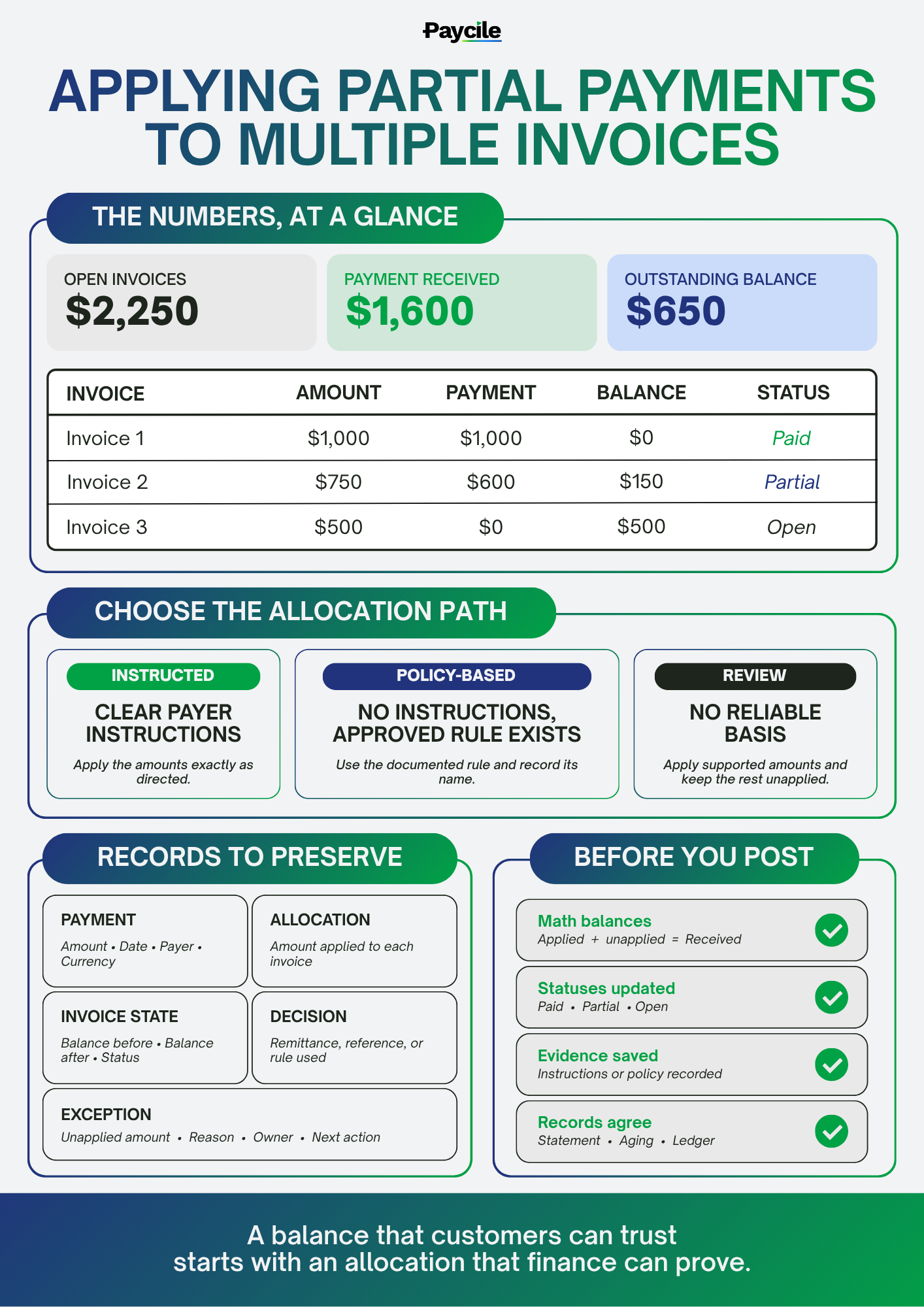
A customer sends $1,600 for three invoices totaling $2,250. Finance can allocate every dollar in the payment while the account still carries $650. One invoice closes, another remains partly paid, and the third receives nothing.
The arithmetic becomes straightforward once the payer's intent is clear. The harder work is making the decision defensible. Finance needs to show which evidence controlled the allocation, how each invoice changed, and what happened to any amount that could not be assigned confidently.
This guide provides a repeatable method for allocating one payment across several invoices without hiding the balances that remain.
Table of Contents
How to Apply a Partial Payment Across Multiple Invoices
Record the incoming payment once, then allocate it line by line according to the payer's instructions. Keep each invoice's original amount and show both the amount applied and the balance remaining. When instructions are missing or conflicting, use an approved allocation policy or hold the uncertain amount as unapplied cash.
One Receipt Can Create Several Invoice Outcomes
Receipt, allocation, and invoice closure are three separate records of what happened.
RECORD | QUESTION IT ANSWERS |
Payment record | How much money arrived, from whom, and when? |
Allocation record | How much of that payment went to each invoice? |
Invoice record | What balance remains after the allocation? |
Keeping those records separate prevents a common source of confusion. A payment can be completely allocated even when the customer still owes money. The payment has no dollars left to assign, but one or more invoices remain open.
Some systems describe this as splitting a payment across invoices. In payment infrastructure, a split payment can also mean dividing one charge among several parties, fees, or accounts. This guide uses the term only for one customer receipt allocated across multiple receivables.
Two calculations show the difference.
- Payment received = amounts applied to invoices + unapplied amount
- Account balance = the remaining balances on all open invoices
The first calculation tests whether finance accounted for the full receipt. The second shows what the customer still owes. Combining them into one “Paid” or “Unpaid” status removes information that collections, support, and the customer may need later.
For the wider process of identifying payers and matching receipts to receivables, see how automated cash application matches payments to invoices.
Start With Evidence That Can Survive a Handoff
The best allocation is the one that another employee can reproduce without asking the original reviewer what they meant.
Use the strongest available evidence in this order.
- Remittance advice listing the invoice numbers and amounts
- Invoice references included with the payment
- Written clarification from the payer
- A documented company allocation policy
- Manual review when the available information is incomplete or contradictory
Treat the payment amount and date as clues rather than instructions. A $3,000 receipt might equal one recent invoice exactly while also covering an older $2,000 invoice and part of another. Amount matching alone cannot reveal which outcome the payer intended.
Before applying the payment, confirm that every candidate invoice belongs to the correct customer, legal entity, and currency. Check that it remains open and that the proposed amount does not exceed its current balance. This matters when a payer handles several subsidiaries or sends one remittance for multiple accounts.
The allocation record should also name its basis. Simple labels such as payer instructed, approved policy applied, and pending clarification show whether the result came from direct evidence, an internal rule, or an unresolved exception.
An oldest-invoice-first rule can provide a consistent fallback, but only when the company has approved it for the account, and the rule fits its contracts and applicable requirements. It should never silently override reliable payer instructions.
Applying a Partial Payment Across Multiple Invoices
Assume a customer has three open invoices worth $2,250 in total. The customer sends $1,600 with instructions to pay Invoice 1 in full and apply the rest to Invoice 2.
Use the following process.
- Record the full $1,600 as one payment.
- Confirm the invoices identified by the payer.
- Apply $1,000 to Invoice 1.
- Apply the remaining $600 to Invoice 2.
- Recalculate the affected invoice balances.
- Confirm that the allocations equal the payment received.
Invoice | Original amount | Payment applied | Remaining balance | Status |
Invoice 1 | $1,000 | $1,000 | $0 | Paid |
Invoice 2 | $750 | $600 | $150 | Partially paid |
Invoice 3 | $500 | $0 | $500 | Open |
Total | $2,250 | $1,600 | $650 |
The second row needs all three amounts. Invoice 2 was originally $750, received $600 from the payment, and now has $150 due. Showing only the original amount and remaining balance forces the reviewer to calculate what happened. Showing the applied amount makes the allocation visible immediately.
After posting, finance should check two totals.
- The payment balance is $0 because the full $1,600 has been allocated.
- The account balance is $650 because Invoice 2 still has $150 due and Invoice 3 still has $500 due.
Those figures describe different parts of the transaction. A zero payment balance confirms that no part of the receipt is waiting for allocation. The $650 account balance confirms that the customer's obligations are not fully settled.
The customer-facing confirmation should be just as clear.
We received your $1,600 payment. We applied $1,000 to Invoice 1 and $600 to Invoice 2. Invoice 2 has $150 remaining, while Invoice 3 remains open for $500.
That message gives the customer enough information to verify the allocation before the next reminder arrives.

What to Do When Instructions Are Missing or Conflicting
Incomplete remittance does not require an all-or-nothing decision. Finance can apply the portion supported by evidence and control the rest as an exception.
AVAILABLE INFORMATION | RECOMMENDED ACTION | RESULTING STATE |
Complete invoice instructions | Apply the payment as directed | Supported allocation |
Instructions explain only part of | Apply the supported portion and hold the rest | Partially unapplied payment |
No instructions, approved default | Apply the documented rule and record its name | Policy-based allocation |
Payment reference and amount | Pause the disputed portion and ask for clarification | Review required |
Several customer accounts | Confirm the correct account before applying | Unapplied cash |
Consider a $1,600 payment with instructions explaining only $1,300. Finance can apply the supported $1,300 and leave $300 unapplied. That preserves the usable evidence without inventing a destination for the remainder.
A different problem appears when the amount equals one invoice but the reference names another. The exact amount creates a plausible match, while the reference creates a competing one. Posting either result without clarification could close the wrong invoice and trigger an inaccurate reminder on the other.
Unapplied cash provides a controlled waiting state for these cases. The record should include the unresolved amount, the reason it remains unapplied, the person responsible for follow-up, and the next action date. Once the payer responds, finance can complete the allocation without rebuilding the investigation.
Do not automatically turn an unexplained remainder into customer credit. A credit represents an approved amount available for later use. Unapplied cash means finance has received money but has not established where it belongs.
A Remaining Balance Can Mean Several Different Things
The same $150 difference can require several accounting and collection responses. Its treatment depends on why the amount remains.
SITUATION | WHAT HAPPENED | APPROPRIATE TREATMENT |
Planned partial payment | The payer intentionally paid part of an invoice | Keep the unpaid amount open under the existing terms |
Short payment | Finance expected full settlement but received less | Investigate the cause and keep the difference visible |
Approved discount | The customer earned or received an authorized reduction | Record the approved adjustment separately |
Credit memo | A formal credit reduces the receivable | Link and apply the credit document to the invoice |
Dispute or deduction | The customer withheld a specific amount | Record the reason, owner, and resolution path |
Processor settlement fee | The customer paid the gross amount and the processor deducted a fee | Apply the gross payment and reconcile the fee separately |
Unapplied cash | Money arrived without enough allocation evidence | Hold the amount until a supported destination is established |
These categories protect the original invoice history. Editing a $750 invoice down to $600 may make one screen balance, but it removes the fact that $150 was billed and still needs a supported outcome.
Payer-deducted bank fees and statutory withholding need their own review. The amount received may be lower than the invoice, yet the difference may follow contractual, tax, or jurisdiction-specific rules. Preserve the payer's explanation and route the difference through the company's approved accounting process.
A remaining balance should therefore carry a reason, not merely a number. That reason determines whether collections should follow up, accounting should post an adjustment, or finance should wait for more evidence.
Build a Record Another Person Can Reproduce
A reliable allocation record connects five layers of information.
LAYER | INFORMATION TO PRESERVE |
Payment | Amount, date, payer, currency, method, receiving account, and transaction ID |
Allocation | Every invoice receiving funds and the exact amount applied to each |
Invoice state | Balance before, balance after, and updated status |
Decision | Remittance, reference, policy, reviewer, and decision time |
Exception | Unapplied or disputed amount, reason, owner, and next action |
This structure gives each team the part it needs without flattening the transaction into a single status. Collections sees the valid open balance. Customer support can explain the payment. Accounting can trace the receipt to the receivables entry. A reviewer can see how the decision was made.
Corrections should preserve that history. If finance later learns that $600 went to the wrong invoice, reverse the original allocation and reapply it using the new evidence. Deleting the first decision can leave statements, collection activity, and ledger entries without a clear explanation.

Four Checks Before You Post the Allocation
A short control check can catch most allocation errors before they reach a statement or aging report.
1. Check the arithmetic
The sum of invoice allocations and any unapplied amount must equal the payment received. No dollar should be counted twice or disappear between the receipt and the invoices.
2. Check the evidence
Every allocation should point to payer instructions or a named company policy. Any unsupported portion should remain in review rather than inheriting a confident-looking match.
3. Check the invoice states
Fully covered invoices should close. Partially covered invoices should retain their remaining balances. Unaffected invoices should remain unchanged.
4. Check the downstream records
The customer statement, aging report, collection queue, and accounting record should reflect the same allocation. A correct entry in one system still creates work when the next system continues showing the old balance.
Frequently Asked Questions
Can one payment be applied to multiple invoices?
Yes. Record the payment once, then assign a specific amount to each invoice it covers. The allocations should equal the payment received unless part of the payment remains unapplied.
Which invoice should receive a partial payment first?
Follow the payer's remittance instructions whenever they are reliable. Without instructions, use the company's approved allocation policy. If neither provides a defensible answer, keep the uncertain amount unapplied while finance requests clarification.
Should a partially paid invoice remain open?
Yes. The payment reduces the invoice's open balance, while the unpaid amount remains due under the applicable terms. Close the invoice only after payments and approved adjustments cover its full balance.
Does fully allocated mean paid in full?
No. Fully allocated means every dollar in the payment has a destination. Paid in full means the affected invoice or customer account has no remaining balance. A payment can be fully allocated while several invoices remain open.
What happens when the allocations do not equal the payment?
Record the difference as unapplied until finance identifies a supported destination or approved treatment. Do not force the difference into an unrelated invoice, discount, write-off, or customer credit merely to make the allocation screen reach zero.
Can an invoice payment allocation be corrected later?
Yes. Reverse the incorrect allocation, restore the affected invoice balances, and reapply the payment using the corrected instructions. Keep the original decision and reversal visible so later reviewers can follow the complete history.

Make the Balance Impossible to Misread
The work continues after every dollar in the payment has been assigned. Finance still needs the invoice history, customer statement, aging report, and accounting record to carry the same answer.
A clear allocation shows what closed, what remains due, and what evidence supports both outcomes. That clarity gives collections a reliable balance and gives the customer a payment history they can verify.
A balance customers can trust starts with an allocation finance can prove.
Paycile connects incoming payments with the records finance needs to explain every balance. Book a demo to see how it works.