Split Payment Reconciliation for Vertical SaaS Platforms


A successful charge can still leave the books wrong.
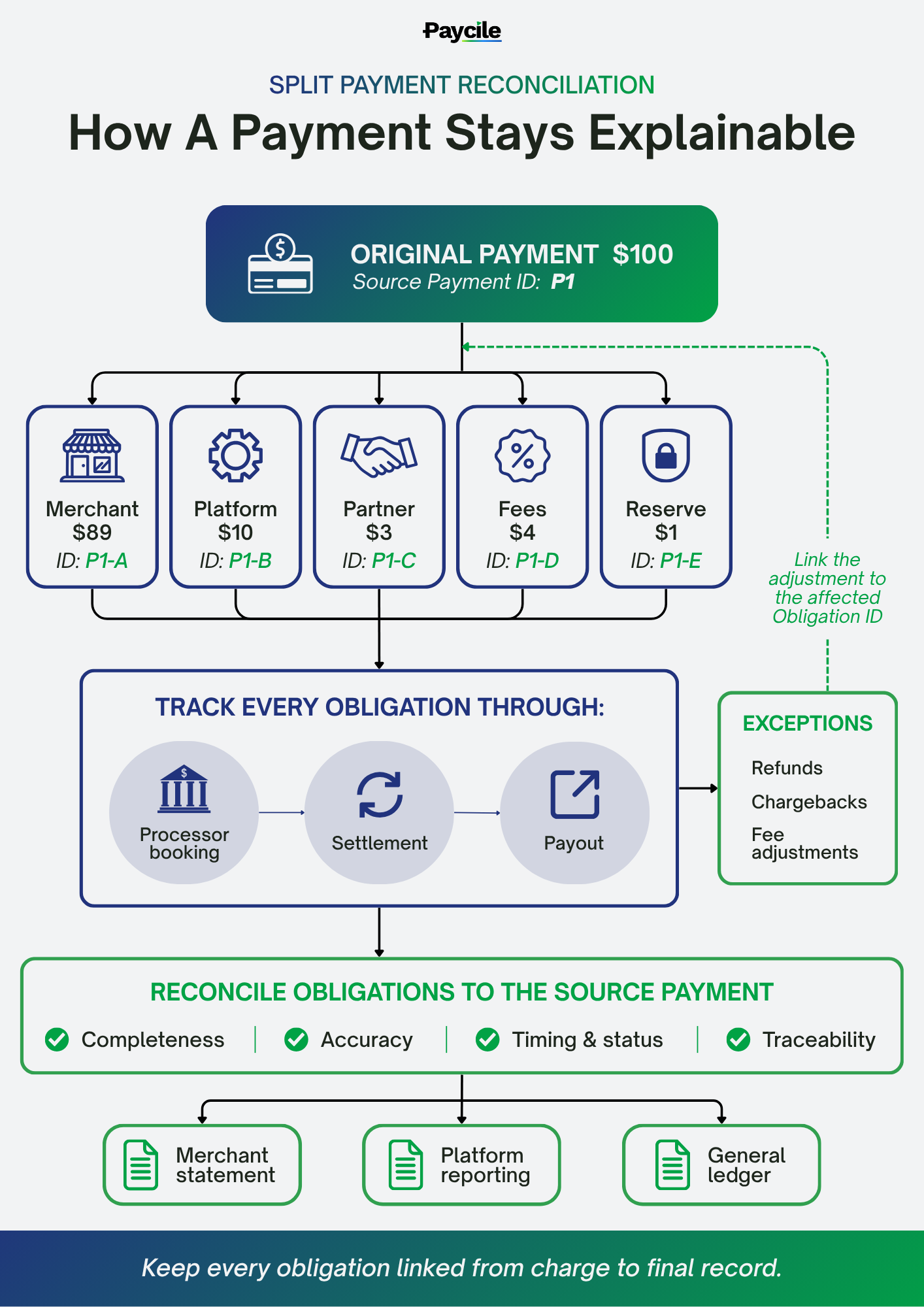
One $100 payment may create merchant proceeds, platform revenue, processor fees, a partner share, and a reserve. Each obligation can follow a different timeline, enter a different system, and fail in a different place.
Until those records reconcile back to the original charge, the platform cannot fully explain the transaction.
This guide shows how split payment reconciliation works, where the record chain breaks, and what vertical SaaS platforms need to trace every dollar through settlement, payout, and reporting.
Table of Contents
What Is Split Payment Reconciliation?
Split payment reconciliation is the process of verifying every financial obligation created when one incoming payment is divided across multiple parties, accounts, or purposes.
Split Payments vs. Split Tender and Partial Payments
The term can describe several different payment scenarios, so the direction of the split matters.
- Split tender uses multiple payment methods to fund one purchase.
- Partial payments use several transactions to satisfy one invoice.
- Split payments take one incoming transaction and distribute its value across several downstream obligations.
Vertical SaaS platforms commonly support the third model. One payment may create merchant proceeds, platform revenue, processor fees, partner commissions, reserves, taxes, or other allocations.
One Payment Creates Several Financial Obligations
Reconciliation must verify the total and each obligation within it. Every obligation needs the correct recipient, allocation rule, settlement status, payout destination, ledger treatment, and link to its source transaction.
Consider an illustrative $100 payment.
Financial obligation | Amount |
Merchant proceeds | $82 |
Platform revenue | $10 |
Partner share | $3 |
Processing costs | $4 |
Reserve or tax allocation | $1 |
Original payment | $100 |
Each child must still be correct on its own, and the complete set must reconcile to the parent transaction.
This obligation-level view extends the broader process of embedded payments reconciliation. It asks where each portion of the payment went, why it went there, and whether every system recorded the same outcome.
Every Split Expands the Reconciliation Surface
Transaction counts describe how many payments entered the platform. They do not show how many financial records those payments created.
One Payment Creates a Record Family
A split payment can produce records across four layers.
- Business context includes the invoice, order, customer, and merchant.
- Allocation intent includes the split instruction and governing rule version.
- Money movement includes the processor booking, settlement line, and payout.
- Financial outcome includes platform revenue, reserves, and ledger entries.
The platform therefore needs a parent-child structure.
The original payment is the parent. Merchant proceeds, fees, commissions, reserves, and later adjustments become children.
Each should identify its source transaction, governing rule, fund movement, and final record.
Timing Differences Need Context
Platform accounting documentation reflects this complexity by separating user shares, commissions, payment fees, taxes, payouts, refunds, and other balance movements.
The records also distinguish between booking dates and value dates because a financial event can be recorded before its funds become available.
Those distinctions matter inside vertical SaaS. The customer payment may be complete while a merchant payout remains pending, platform revenue awaits settlement, or a reserve stays restricted.
When timing lacks context, normal lifecycle differences can look like financial errors.
Persistent identifiers, rule versions, and lifecycle statuses allow finance and operations teams to distinguish normal timing differences from actual errors.
Without them, multi-party payment reconciliation becomes a search across systems that were never designed to explain one another.
Where Split Payment Records Lose Their Connection
Split payment failures rarely begin with a dramatic system outage. They usually begin with one amount, reference, or status that no longer agrees with the rest of the payment history.
Allocation Rules Drift from Actual Amounts
Split logic can depend on merchant contracts, service categories, locations, commission tiers, or partner agreements. Those rules change over time.
If the platform cannot identify which version governed a transaction, finance may see the amount that moved without being able to prove why it was correct.
Percentage splits also create rounding decisions that must be applied consistently. A few cents placed in the wrong account across thousands of transactions becomes a material balance.
Fees Break the Gross-to-Net Story
Processing costs may be paid by the merchant, absorbed by the platform, shared between parties, or separated into several fee categories. Net settlement can hide that detail.
A bank deposit may reconcile to the processor total while the platform still misstates gross merchant proceeds or payment revenue.
Accurate payment allocation reconciliation must preserve both the gross transaction and every deduction that produced the net result.
Settlements and Payouts Fall Out of Step
Authorization, capture, booking, settlement, availability, and payout are separate states. One obligation may be available today while another remains pending or restricted.
Aggregated settlement files create another challenge.
A bank deposit may contain hundreds of transactions and adjustments. If split records lack stable references, the total can match while individual merchant and platform balances remain unexplained.
Refunds and Chargebacks Lose the Original Split
A refund may reduce merchant proceeds, reverse platform revenue, recalculate a partner commission, release a reserve, and create a nonrecoverable processing cost alongside the amount returned to the customer.
Chargebacks can arrive after payouts and reporting are complete. The resulting debit still needs to follow the platform’s liability rules and remain connected to the original sale.
That connection is what allows finance to unwind the correct obligations instead of applying a broad adjustment to whichever account is easiest to reach.
Manual Corrections End the Audit Trail
A spreadsheet can correct a balance without repairing the transaction history. The next statement, refund, or close process still relies on incomplete data.
The table below shows how common breaks surface.
RECONCILIATION BREAK | FINANCIAL EFFECT | EVIDENCE REQUIRED |
Outdated or missing split rule | Incorrect payout or platform revenue | Rule version and source agreement |
Missing parent-child reference | Untraceable obligation | Transaction, split, and settlement IDs |
Incorrect fee assignment | Gross-to-net or margin mismatch | Transaction-level fee detail |
Timing or status drift | False exception or premature reporting | Booking, value, and payout dates |
Incomplete reversal | Stale balances after a refund or dispute | Original allocation and linked reversal |
These gaps spread into merchant trust, customer support, revenue reporting, and the speed of financial close.
How Split Payment Reconciliation Should Work
A reliable process reconciles the payment at two levels. It verifies the parent transaction, then verifies each obligation that came from it.
Reconcile the Parent Transaction
Begin with the platform’s source record. Confirm the customer, invoice or order, gross amount, currency, payment method, and status.
Match it to the processor event using a persistent identifier. The parent establishes the value available for distribution and the context behind the payment.
Verify Every Child Obligation
Compare the intended split with the amounts the processor booked. Verify the recipient, balance account, fee category, commission, reserve, and other allocation details.
References are critical at this stage. Split payment implementation guidance warns that split amounts can be aggregated and become impossible to reconcile individually when references are missing.
Each child record should retain the parent transaction ID along with its own obligation type and status.
This structure supports marketplace payment reconciliation and other vertical SaaS models without losing the relationship between one customer action and multiple financial outcomes.
Tie Gross Payment to Net Settlement
The full set of obligations must agree with the original payment.
Start with the gross amount. Apply refunds, processing costs, partner shares, reserves, and later adjustments according to the operating model. The result should explain the amount available for payout and what reached each destination.
Settlement batches then need to connect those transaction-level results to bank activity.
Itemized payout reconciliation data can expose the individual payments and adjustments contained in a deposit, which is more useful than matching only the batch total.
Confirm Payouts and Ledger Entries
Once funds settle, confirm that each obligation reached the correct bank account, balance account, or internal destination. Then, verify the accounting treatment.
Merchant proceeds, platform revenue, processor costs, commissions, reserves, and customer liabilities serve different purposes. One net entry may balance the ledger while hiding errors in the underlying obligations.
Merchant statements, product reporting, internal dashboards, and the general ledger should all derive from the same transaction history.
Otherwise, each output can be internally consistent while disagreeing with the others.
Keep Post-Payment Events Connected
Refunds, disputes, failed payouts, fee corrections, and returns should extend the payment history as new events.
Partner financial reporting structures include parent, related, and original transaction identifiers for this reason. The links make it possible to trace commissions, fees, reversals, and payouts back to the original sale.
Four controls determine whether the complete process works.
- Completeness confirms that every expected obligation exists.
- Accuracy confirms that amounts and allocation rules are correct.
- Timing and status show where each obligation sits in its lifecycle.
- Traceability connects every record and adjustment to its source.
Together, these controls turn split settlement reconciliation from a batch comparison into a continuous explanation of how money moved.

Build an Obligation Map for One Payment Flow
A platform can evaluate its current process without reviewing every transaction. Start with one common split configuration and map the complete financial path.
For each obligation, document the following fields.
- Original transaction ID
- Obligation type
- Recipient or destination account
- Allocation rule and version
- Expected amount
- Processor reference
- Settlement or payout reference
- Ledger account
- Current status
- Exception owner
Map the Expected Flow
Run the map against a normal settlement. Confirm that every child obligation exists, the amounts add back to the parent, and each destination has supporting evidence.
Stress-Test the Split
Run the same map against a partial refund, full chargeback, processing-fee adjustment, and failed payout. These scenarios expose gaps that a successful transaction can leave hidden.
A process may handle the original split correctly while losing the relationship during a reversal.
The test also reveals where operational knowledge lives.
If one person must interpret processor codes, retrieve a private spreadsheet, or reconstruct allocation logic from an old contract, the system does not yet carry enough context.
Turn the Gaps Into Reconciliation Requirements
Scalable split payout reconciliation needs several capabilities working together.
- Transaction-level parent and child records
- Configurable, versioned allocation rules
- Automated gross-to-net matching
- Obligation-level lifecycle tracking
- Structured exception ownership and resolution
- Audit-ready reporting
- Connections to processor, bank, and accounting data
These capabilities do not require a platform to replace every financial system it already uses.
It is possible to have embedded finance operations without rebuilding your platform. All it takes is a connected operational layer that can preserve existing payment, banking, and accounting relationships while keeping their records aligned.

Every Split Creates a Proof Burden
Every split creates a financial claim that the platform must be able to defend.
A vertical SaaS platform should be able to show why each amount exists, where it moved, what changed afterward, and how the final result reached the books.
When that chain holds, merchant payouts, platform revenue, reserves, refunds, and reporting all share one financial history.
Growth exposes every obligation the platform cannot trace. What begins as a few unexplained cents eventually appears as payout disputes, revenue uncertainty, and close processes built on reconstruction.
Money movement tells you where the dollar went. Reconciliation proves it belonged there.
Want to know how Paycile keeps split payment obligations connected from transaction through settlement and reporting? See it for vertical SaaS.