NSF Returns Explained Beyond the Failed Payment


A successful payment is only half the job.
The real challenge is what happens when that payment doesn't settle as expected.
An NSF return doesn't stop with a failed transaction. It can trigger reconciliation gaps, payout adjustments, ledger mismatches, and manual investigations across multiple systems.
As embedded payments scale, handling those exceptions becomes just as important as processing payments in the first place.
This guide explains how NSF returns create operational complexity and what SaaS platforms should do to manage them at scale.
Table of Contents
What Is an NSF Return?
An NSF (Non-Sufficient Funds) return occurs when a payment cannot be completed because the payer's bank account doesn't have enough available funds to cover the transaction.
In ACH payments, this typically means the payment was submitted successfully but later returned by the receiving bank after the account balance was verified. The transaction that initially appeared to be moving forward is ultimately reversed.
From a payment processing perspective, that's a straightforward explanation.
From an operations perspective, however, it's only the beginning.
When an embedded payments platform receives notice of an NSF return, the platform isn't simply recording a failed payment. It now has to determine what happened after that payment was initiated.
Questions immediately arise:
- Has the customer's balance already been updated?
- Has revenue already been recognized?
- Were funds already allocated internally?
- Has a payout already been scheduled?
- Has the finance team already reconciled the transaction?
The answers often involve multiple systems rather than a single payment record.
The Operational Unwind Starts After the Payment Fails
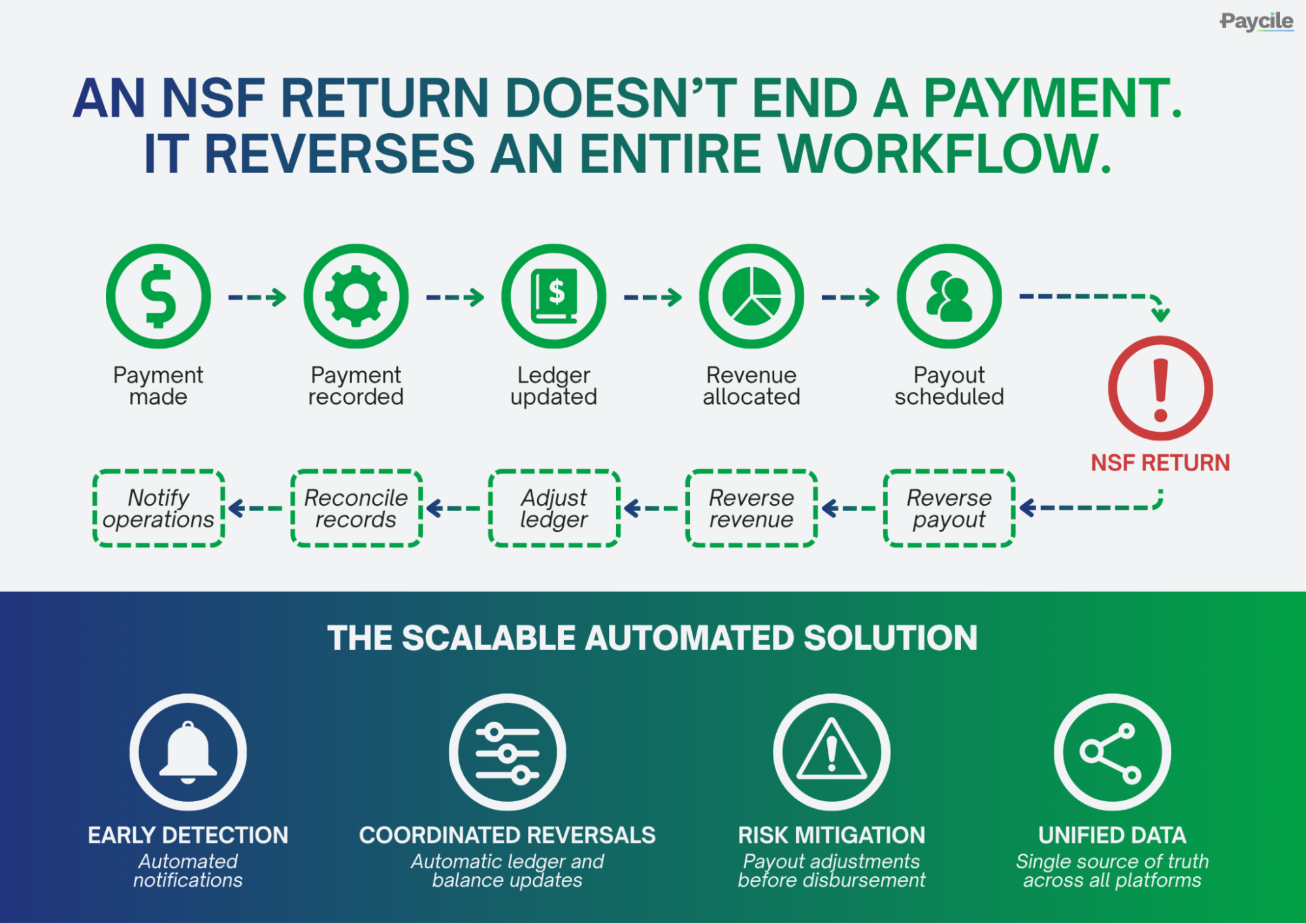
An NSF return is the beginning of an operational exception that must be resolved across every system affected by the original transaction.
Consider a typical embedded payments workflow:
- A customer initiates a payment.
- The platform records the transaction.
- Internal ledgers are updated.
- Revenue allocations are calculated.
- Merchant or customer payouts are scheduled.
- Finance teams expect the funds to settle.
An NSF return requires each of those financial movements to be reviewed and, where necessary, reversed in a controlled and traceable manner.
Reconciliation records must reflect the returned funds, while reporting and audit trails must continue to present an accurate financial picture.
For platforms supporting multi-party payment flows, the impact extends even further:
- A property management platform may have allocated a rent payment across property owners, management fees, and trust accounts.
- An HOA platform may have distributed assessment payments across multiple operating and reserve funds.
- A field service platform may have initiated contractor payouts based on customer payments that were expected to settle.
This is where payment operations become significantly more complex than payment processing.
Why NSF Returns Create Reconciliation Problems
Reconciliation depends on a single principle: Every system involved in a transaction should ultimately reflect the same financial outcome.
In an embedded payments environment, however, that outcome is recorded across multiple systems rather than a single source of truth.
One transaction may be represented in bank records, payment processor data, internal platform ledgers, merchant or customer accounts, accounting systems, and financial reporting tools. Each serves a different operational purpose and follows its own update cycle.
An NSF return disrupts that synchronization.
While the bank reflects the returned payment, other systems may still recognize the transaction as settled:
- Revenue may have already been recognized.
- Customer balances may remain unchanged.
- Scheduled payouts may still be pending.
- Financial reports may continue to include funds that are no longer expected to clear.
The challenge isn't that these systems contain incorrect information. It's that they often receive and process the same event at different points in time.
Without a coordinated reconciliation process, those timing differences create inconsistencies between operational and financial records.
Finance teams spend time validating balances across multiple systems, operations teams investigate exceptions to determine where discrepancies originated, and customer support may be forced to resolve questions created by conflicting account information.
As transaction volume increases, so does the number of exceptions requiring review. What begins as a handful of isolated investigations can quickly become a recurring operational workload that delays month-end close, reduces visibility into cash position, and increases the risk of reporting errors.
For embedded payments platforms, reconciliation is therefore much more than matching bank transactions. It's the process of ensuring that every ledger, balance, allocation, and financial record continues to represent the same underlying reality, even when payments don't settle as originally expected.
Building a Scalable NSF Return Process
As transaction volumes increase, manual exception handling becomes increasingly difficult to sustain.
Every NSF return introduces a series of operational tasks that extend well beyond the returned payment itself, including reconciliation updates, ledger adjustments, revenue reversals, payout reviews, and customer account corrections.
Managing those activities through disconnected workflows increases the likelihood of delays, inconsistent records, and reconciliation gaps, particularly when multiple teams and systems are involved.
Rather than treating each NSF return as a standalone event, embedded payments platforms should establish standardized workflows that coordinate the entire operational response.
Automation ensures that every downstream process is triggered consistently, reducing the risk that one system reflects the returned payment while another continues to operate on outdated information.
A scalable NSF return process should be capable of:
- Detecting returned payments as soon as notification is received
- Initiating reconciliation workflows automatically
- Reversing revenue allocations and ledger entries where required
- Updating customer, merchant, and platform balances consistently
- Reviewing or adjusting scheduled payouts before funds are disbursed
- Maintaining a complete audit trail for every operational action
- Escalating only those exceptions that require human investigation
More than eliminating manual effort, the objective is to ensure that every financial system responds to the same event in a consistent and repeatable manner.
As embedded payments become a larger part of SaaS platforms, maintaining that level of operational consistency becomes increasingly important.
Automation enables finance and payment operations teams to scale exception handling without sacrificing reconciliation accuracy, financial visibility, or audit readiness.

Evaluating the Maturity of Your NSF Return Process
Handling the occasional NSF return is rarely the challenge. The real test is whether your payment operations can manage returned payments consistently as transaction volume, payment complexity, and customer expectations continue to grow.
An effective NSF return process should extend beyond detecting failed payments. It should provide complete visibility into how those payment exceptions affect reconciliation, payouts, financial reporting, and every downstream system connected to the transaction.
When evaluating your current process, consider the following questions:
- How quickly can your platform identify an NSF return?
Timely visibility is the foundation of an effective operational response. The longer it takes to identify a returned payment, the greater the likelihood that downstream processes, such as reconciliation, revenue recognition, or scheduled payouts, continue operating on outdated assumptions.
- Is the reconciliation process automated or dependent on manual intervention?
Every returned payment should trigger a consistent reconciliation workflow. If finance teams are manually comparing spreadsheets, cross-checking reports, or investigating discrepancies one transaction at a time, the process is unlikely to scale as payment volume increases.
- Can every reversal be traced across every affected system?
An NSF return doesn't only affect the bank transaction. It also affects internal ledgers, customer or merchant balances, accounting records, reporting, and audit documentation. Finance teams should be able to trace the complete lifecycle of a returned payment without relying on disconnected systems or manual reconciliation.
- Are downstream financial processes updated automatically?
Scheduled payouts, revenue allocations, and other financial workflows should respond automatically when a payment is returned. Continuing with downstream activities based on funds that are no longer expected to settle introduces unnecessary operational and financial risk.
- Do all teams operate from the same source of truth?
Finance, payment operations, customer support, and product teams often interact with the same transaction for different reasons. When each team relies on different records or reporting systems, resolving payment exceptions becomes slower, more complex, and more susceptible to error.
Ultimately, evaluating an NSF return process isn't about measuring how quickly a failed payment can be identified. It's about determining whether every operational system responds to that event accurately, consistently, and in coordination with the rest of the payment lifecycle.
As embedded payments continue to scale, payment exceptions become an expected part of day-to-day operations rather than an occasional disruption.
Platforms that establish standardized, automated workflows are better equipped to maintain reconciliation accuracy, financial visibility, and operational resilience as transaction volumes grow.

Payment Exceptions Are Part of the Product Experience
Every embedded payments platform will encounter NSF returns. They aren't unusual, and they aren't necessarily a sign that something is wrong. They're an expected part of moving money at scale.
What separates mature payment operations from reactive ones is how those exceptions are handled.
An NSF return doesn't just affect a single transaction. It has the potential to impact reconciliation, trust accounting, revenue allocation, payouts, reporting, and every downstream system that depends on accurate financial data.
As payment volume grows, managing those operational dependencies becomes just as important as processing payments in the first place.
The goal shouldn’t be to eliminate payment exceptions but rather to build operational processes that can detect them early, coordinate the appropriate response, and maintain a consistent financial picture across every system involved.
For embedded payments platforms, that's what enables sustainable growth.
When payment exceptions become routine rather than disruptive, finance and operations teams can spend less time resolving discrepancies and more time supporting the business.
Managing NSF returns shouldn't depend on spreadsheets, manual investigations, or disconnected systems. Learn how Paycile helps SaaS platforms improve reconciliation, strengthen operational visibility, and stay ahead of payment exceptions. Book a demo with us.