Three-Way Reconciliation Explained for Modern SaaS Platforms


Every payment creates multiple versions of the truth.
Your product says the customer paid. Your payment processor records how the transaction moved. Your bank shows what actually settled.
These records line up most of the time, but reconciliation only gets more complex as payment operations grow. That's when it stops being an accounting task and becomes an operational challenge.
For SaaS platforms with embedded payments, comparing two records is rarely enough. Fees, settlement timing, refunds, chargebacks, and split payouts all create opportunities for financial records to drift apart.
Three-way reconciliation helps bring those records back together, giving finance and operations teams a complete view of every transaction from initiation to settlement.
Let’s learn about three-way reconciliation through a SaaS lens. We’ll go through why mismatches occur, how to diagnose them, and how to improve payment operations with practical steps and questions.
Table of Contents
What Is Three-Way Reconciliation?
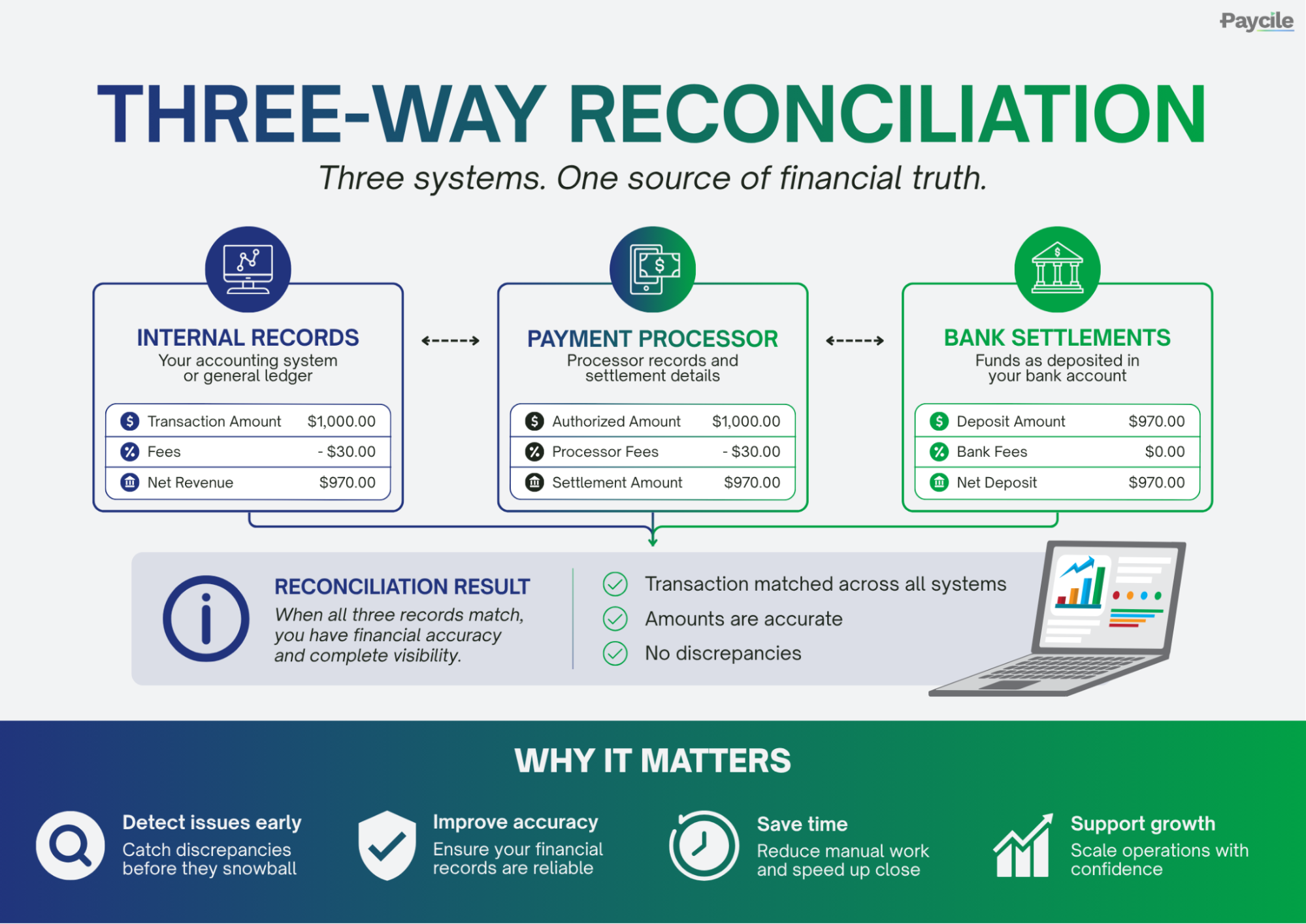
At its core, three-way reconciliation is the process of comparing three independent financial records to verify that every transaction is complete and accurate.
For modern SaaS payment operations, those three records are typically:
- Internal financial records or ledger. These reflect what your platform believes happened.
- Payment processor's transaction data. This records how the transaction moved through the payment network.
- Bank settlement records. These confirm what money was actually received or paid out.
Each system tells part of the story.
If all three records align, you can be confident your financial data is accurate. If they don't, you have a discrepancy that requires investigation.
Three-Way vs. Bank Reconciliation
Traditional bank reconciliation typically compares only internal records against bank statements.
That approach may work for simpler payment environments. However, embedded payments introduce additional transaction states, fees, settlement timing, and payment events that require another layer of validation.
Embedded payments reconciliation gives finance and operations teams a more complete picture of every transaction from payment initiation through final settlement.
Where Payment Records Start to Drift
Many reconciliation issues begin with successful payments that are recorded differently across multiple systems.
There are plenty of legitimate reasons why this happens:
- Settlement often occurs hours or days after authorization.
- Payment processors deduct processing fees before funds reach your bank.
- Refunds may be processed separately from the original transaction.
- Chargebacks introduce entirely new financial events.
- Platforms supporting marketplaces or revenue sharing may split a single payment into multiple payouts.
None of these situations necessarily indicate something is wrong. They are simply part of modern payment operations.
Two Records Rarely Tell the Whole Story
The problem arises when teams only compare two records.
For example, your bank deposit may match the processor's settlement amount, but your internal ledger may still show the original transaction value before fees or adjustments. Likewise, processor records may reflect a refund that hasn't yet been recorded internally.
Without comparing all three sources, these differences often remain hidden until month-end, audits, or customer inquiries expose them.
Three-way reconciliation helps identify these mismatches earlier, making them easier to investigate and resolve.
Small Gaps Become Expensive Problems
A single reconciliation discrepancy may seem insignificant, but hundreds or thousands of them quickly become an operational problem.
As payment volume increases, small mismatches accumulate across settlements, fees, refunds, and payouts. As a result:
- Finance teams spend more time investigating exceptions instead of analyzing performance.
- Month-end close takes longer.
- Customer support receives more payment-related questions.
- Audit preparation becomes more difficult because teams must manually trace transactions across disconnected systems.
Perhaps most importantly, leaders lose confidence in their financial data.
When different systems report different balances, answering simple questions becomes a challenge.
How much revenue was actually collected? Which settlements are still outstanding? Have all refunds been accounted for? Which transactions require investigation?
Without reliable reconciliation, every report carries an element of uncertainty.
This is one of the biggest operational challenges for SaaS companies that offer embedded payments. The payment experience may feel seamless to customers, but the financial operations behind it become more difficult to manage.
Reconciliation Shouldn't Wait Until Month-End
Traditional reconciliation is often treated as a monthly finance task. However, modern payment operations don't move at a monthly pace.
Transactions occur throughout the day. Refunds happen continuously. Chargebacks arrive unexpectedly. Settlement files are generated daily.
Waiting until the end of the month allows discrepancies to accumulate, making them harder to identify and resolve.
This is why many SaaS platforms are shifting toward continuous reconciliation.
Rather than reviewing thousands of transactions weeks later, automated reconciliation continuously compares payment records as new data becomes available. Exceptions are identified sooner, allowing finance teams to investigate while supporting information is still readily available.
Visibility Becomes a Competitive Advantage
Continuous reconciliation also creates stronger operational visibility by providing:
- Faster exception detection
- Automated transaction matching
- Clear audit trails
- Reduced manual spreadsheet work
- More accurate financial reporting
- Greater confidence in payment operations
Automation doesn't eliminate the need for reconciliation. It makes reconciliation practical at the scale modern SaaS businesses require.

Putting Three-Way Reconciliation Into Practice
Understanding the concept is one thing. Applying it effectively is another.
Whether you're building a new payment operation or improving an existing one, three-way reconciliation should be more than a periodic finance task. It should provide a reliable framework for verifying that every transaction has been processed, settled, and recorded correctly.
How to Perform Three-Way Reconciliation
While every organization has its own workflow, the reconciliation process generally follows the same five steps.
1. Gather your three data sources.
Collect the records you want to compare over the same reporting period.
2. Match transactions across all three records.
Use unique identifiers such as transaction IDs, payment references, or settlement IDs to verify that each payment appears consistently across every system.
3. Investigate any discrepancies.
If a transaction doesn't match, determine why before making adjustments. Some differences are expected, while others may point to missing data or recording errors.
4. Resolve and document exceptions.
Correct any confirmed issues and keep a record of how they were resolved. Consistent documentation supports future audits, simplifies investigations, and helps identify recurring patterns over time.
5. Repeat the process regularly.
The sooner discrepancies are identified, the easier they are to resolve. Establishing a consistent reconciliation schedule helps prevent small issues from accumulating into larger operational problems.
What Good Three-Way Reconciliation Looks Like
Three-way reconciliation isn't just about finding discrepancies. It's also a useful way to evaluate the strength of your payment operations.
As you review your current process, ask yourself:
- Are all three financial records being reconciled consistently?
- How quickly can discrepancies be identified and investigated?
- Can every exception be traced back to its source?
- How much of the reconciliation process still depends on manual work?
- Would your current process still be effective if transaction volume doubled?
The answers to these questions often reveal whether your reconciliation process is supporting growth or simply keeping up with today's workload.
Knowing When It's Time to Automate
Not every business needs automated reconciliation from day one. For smaller payment volumes, a manual process may be sufficient.
As operations grow, however, manual reconciliation often becomes harder to sustain. It may be time to consider automation if:
- Reconciliation takes several days to complete.
- Month-end close is routinely delayed by payment investigations.
- Finance teams spend more time resolving exceptions than analyzing results.
- Payment discrepancies become increasingly difficult to trace.
- Confidence in financial reporting starts to decline.
Automation doesn't replace financial oversight. It reduces the manual effort required to maintain it, allowing finance teams to focus on resolving meaningful exceptions instead of matching routine transactions.
Frequently Asked Questions
Why isn't two-way reconciliation enough?
Two-way reconciliation often misses timing differences, processing fees, refunds, chargebacks, and split payouts. These events may appear differently across payment processors, banks, and internal systems, making a third data source essential for maintaining financial accuracy.
Can three-way reconciliation support embedded payments?
Yes. Embedded payments introduce additional payment events, settlement timing differences, and multi-party fund flows. Three-way reconciliation helps SaaS platforms maintain accurate financial records across these increasingly complex payment operations.
What software supports three-way reconciliation?
The right software depends on your payment environment. Some businesses use ERP or accounting systems with built-in reconciliation capabilities, while others rely on specialized reconciliation platforms that integrate with payment processors, banks, and financial systems. SaaS platforms with embedded payments often benefit from purpose-built reconciliation solutions that can handle transaction matching, settlement data, split payouts, refunds, chargebacks, and exception management across multiple data sources.
How often do trust accounts need to be reconciled?
While this guide focuses on SaaS payment operations, three-way reconciliation is also widely used for trust accounting in industries such as property management and legal services.
Trust accounts are commonly reconciled at least once a month. Although, many organizations perform reconciliations more frequently, such as weekly or even daily, to identify discrepancies sooner. Regular transaction reconciliation helps ensure that records remain aligned while supporting compliance and audit requirements.

Growth Exposes Every Reconciliation Gap
Most payment operations fail because financial records stop telling the same story.
As transaction volume increases, even small timing differences, fees, refunds, and split payouts can create discrepancies that ripple across reporting, customer support, and financial operations.
Three-way reconciliation helps eliminate that uncertainty by connecting your internal records, payment processor data, and bank settlements into a single source of financial truth.
For SaaS platforms, it's no longer just a finance process. It's a foundation for accurate reporting, operational visibility, and confident growth.
Want to learn how Paycile helps SaaS teams automate continuous reconciliation and maintain visibility across every stage of the payment lifecycle? Connect with us!