What Property Management Trust Accounting Requires From Software


Trust-account compliance is often tested long after the transaction created the evidence.
An owner questions a disbursement. A returned payment changes an available balance. A regulator requests support from a previous period.
The accounting team must prove why the movement was valid, who authorized it, and whose balance changed.
That proof begins inside the software handling the workflow. Every receipt, allocation, adjustment, and disbursement either preserves its financial context or forces someone to reconstruct it later.
For property management trust accounting, correct totals are the starting point. The software must also retain an attributable, reviewable history from the moment funds arrive through their final resolution.
This article examines the records, controls, and reconciliation support that make that history defensible.
Table of Contents
The Record Begins When the Funds Arrive
Property managers regularly handle money that belongs to someone else.
Rent may be due to an owner. A security deposit may remain the tenant’s property until the lease and applicable law determine its disposition. Reserve funds may be held for repairs. Association money may carry its own restrictions.
Trust accounting keeps those funds separate from the management company’s operating money and records the interest of every owner, tenant, association, or other beneficiary.
The applicable requirements vary by state, account type, and the role of the company holding the funds. Qualified legal and accounting guidance remains essential.
The Workflow Carries the Proof Forward
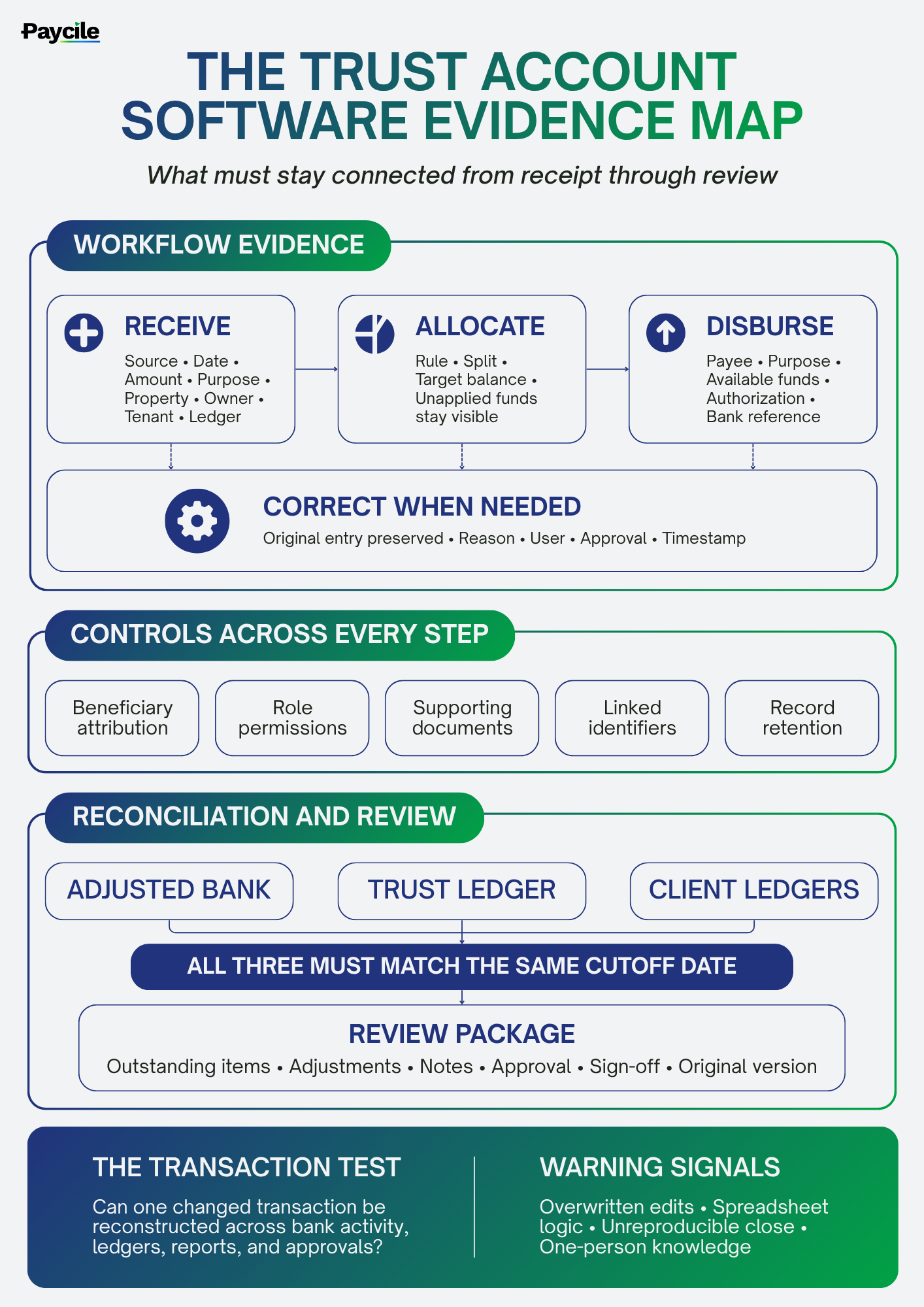
A trust workflow extends from receipt through identification, allocation, disbursement, adjustment, reconciliation, and reporting. Each stage creates information the organization may need years later.
A 2025 review of common trust-fund enforcement violations identified commingling, missed reconciliations, and incomplete transaction records among recurring problems.
Those outcomes can begin when a receipt reaches the wrong account, an adjustment loses its reason, or a disbursement lacks evidence of authorization.
The software should preserve enough context to answer four questions about every movement:
- Whose money was involved?
- Why did it move?
- Who authorized it?
- Which records and balances changed?
When those answers travel with the transaction, reports can be traced to their source. When they separate, even an accurate ending balance can become difficult to defend.
Every Movement Needs a Financial Identity
A bank transaction proves that money moved, but it does not fully explain what the money represented.
Receipt records should preserve the date, amount, source, purpose, and applicable agreement. They should connect the funds to the correct property, owner, tenant, and ledger.
If one payment covers several obligations, the allocation should show how it was divided and which rule produced the result.
A disbursement record should identify the payee, purpose, authorization, available balance, and bank reference. It should also show which owner or tenant balance funded it.
Official trust-account audit-trail requirements in Washington call for an audit trail, individual client identification, and receipt records showing the date, amount, source, and purpose.
Other states use different language, but the operational demand is recognizable. Each movement needs enough identity to be traced back to the person and obligation behind it.
WORKFLOW ACTION | EVIDENCE THE SOFTWARE SHOULD PRESERVE |
Receipt | Source, date, amount, purpose, payer, and beneficiary |
Allocation | Rule, amount, property, owner, tenant, and target ledger |
Adjustment | Original entry, reason, user, approver, and affected balances |
Disbursement | Payee, authorization, available funds, and bank reference |
A pooled property management trust account may show one bank balance while the company remains responsible for many obligations inside it.
The software must preserve the subledger detail for each beneficiary.
Consider a deposit covering rent for three units. The bank total can be correct while one unit receives the wrong allocation. The error may remain hidden until owner statements, disbursements, or reconciliation rely on it.
Unidentified and partially allocated funds need a visible status. An unresolved queue preserves the work still required. Posting them to a convenient property or general balance weakens the record.
Corrections Need Their Own Record
Trust workflows rarely follow a perfect sequence. Payments return. Checks are voided. Charges are reclassified. Management fees are corrected. A disbursement may need to be reversed or reissued.
Preserve the Original Event
The system should allow corrections while keeping the original event visible.
Reversals should create linked counter-entries. Reclassifications and manual adjustments should retain the amount, affected ledgers, reason, user, approval, and time.
This history matters because one correction may reach several records. A returned rent payment, for example, may affect the tenant balance, owner allocation, expected deposit, disbursement, and month-end report.
The original receipt still explains why those downstream entries existed. Deleting or overwriting it removes the starting point for the investigation.
Paycile’s guide to rent payment reconciliation for property managers examines how these payment events create wider reconciliation work.
Make Authority Visible
Permissions form another part of the record. The software should distinguish the authority to receive funds, post entries, approve disbursements, make adjustments, and complete reconciliation.
Approval thresholds and separate roles create evidence that the workflow followed the company’s control structure.
Delegating the work does not necessarily transfer responsibility.
Current trust-account supervision guidance from North Carolina emphasizes that the broker-in-charge remains responsible even when an assistant, accountant, or bookkeeper maintains the records. It also points to the reports software must be able to produce for compliant oversight.
Supporting documentation should remain connected to the event it explains. The transaction history should lead a reviewer directly to invoices, owner instructions, deposit records, approvals, and correction support.
Corrections should be possible and visible. A complete history gives finance teams room to fix errors without erasing how the account reached its current position.
Reconciliation Starts Upstream
Three-way reconciliation compares the adjusted bank balance, the trust ledger, and the combined balances of the individual client ledgers at the same cutoff date.
The monthly comparison only tests the records created throughout the period.
A receipt assigned to the wrong beneficiary can still appear in the bank and trust ledger totals. The problem becomes visible when the client-level balances are examined.
A correction posted after the cutoff may create a different explanation in the current system than the one that existed when the report was first prepared.
Effective trust account reconciliation depends on software that preserves the totals and the items explaining them.
A complete reconciliation record should keep the following evidence together:
- The bank statement, trust ledger, and client-ledger totals for the same cutoff date
- Outstanding checks, deposits in transit, unapplied receipts, reversals, bank errors, and stale transactions
- Adjustments and the supporting documents behind them
- Reviewer notes, approval, and final sign-off
- The version used for the original review, followed by any later changes
Negative owner or tenant balances should remain visible before they are absorbed into a portfolio-level total. If a period is reopened, the system should show what changed and why.
Retention requirements also shape the software decision.
Texas, for example, requires documentary records of trust-account deposits and withdrawals to be retained for four years. Other states apply different periods and conditions.
A software export that captures only the current balance offers little protection when the supporting history is no longer available.
Reconciliation reports are useful because they compress a large volume of activity into a reviewable result.
Their reliability still depends on the evidence built upstream. A polished report cannot restore an allocation rule, approval, or beneficiary link that the workflow never recorded.

Evaluate Software With a Transaction Test
A feature list can confirm that software offers ledgers, permissions, reconciliation, and reporting. A transaction test shows whether those capabilities remain connected when the workflow becomes complicated.
Choose one payment that changed course, such as a partial payment, adjusted owner disbursement, voided check, or return posted after reporting. Trace it from receipt through final resolution.
When evaluating property management trust accounting software, work through the following questions:
- Can the system establish the original financial identity?
Confirm that the receipt shows the payer, source, amount, date, purpose, property, beneficiary, and target ledger. Verify that external processor or bank references follow it into the accounting record.
- Can finance explain the allocation?
Review how the amount was distributed across obligations. The system should preserve the rule, resulting amounts, and any unapplied remainder without relying on a separate worksheet.
- Does every change remain linked to the original event?
Follow every reversal, correction, refund, transfer, and manual entry. Each change should identify the reason, user, approval, timestamp, and affected balances while preserving the original event.
- Can the transaction be followed into the bank and ledgers?
Confirm that finance can connect the software record with the bank activity, trust ledger, and applicable client ledgers. Note any missing or inconsistent identifiers.
- Can the team recreate the period as it was reviewed?
Run the reports using the original cutoff. Confirm that outstanding items, adjustment support, reviewer notes, approvals, and the reported balances remain reproducible.
- Can the software produce a complete review package?
The package should include the transaction history, beneficiary detail, bank support, ledgers, reconciliation, adjustments, and sign-offs. Exported records should retain their relationships outside the system.
What to Watch Out For
Several warning signs deserve immediate attention:
- Staff needs to open multiple systems to reconstruct one movement.
- Beneficiary detail or allocation logic exists only in spreadsheets.
- Manual adjustments overwrite earlier activity.
- Reports provide totals without the transactions behind them.
- Reconciliation cannot be reproduced using the original cutoff.
- One employee holds the only reliable explanation of the process.
Requirements differ by jurisdiction. Useful trust accounting software for property managers should support configurable records, controls, permissions, reporting, and retention.
The company remains responsible for determining which rules apply.
The strongest evaluation question is simple: Can the software reproduce the complete financial history of a transaction after that transaction changes course?

The Record Must Outlast the Transaction
Money can move in seconds. Questions may arrive years later.
A defensible trust-account workflow keeps every event tied to the person, purpose, authorization, and balance it affected. Those connections should survive corrections, month-end close, software exports, and staff changes.
Property management software carries part of the compliance burden whenever it records, allocates, adjusts, or reports trust activity. Intact evidence makes reconciliation reproducible and oversight practical.
A trust-account workflow earns confidence when every dollar can still explain where it came from, why it moved, who authorized it, and whose balance changed.
See how Paycile helps property management teams connect payment activity, reconciliation, and reporting across their existing systems.
Curious about something else? Let’s have a quick chat!