Embedded Payments Maturity Model for Vertical SaaS


A platform can reach PayFac status and still operate an immature payments business.
The commercial opportunity may expand quickly, while the processes supporting reconciliation, exceptions, reporting, and financial control develop at a different pace.
Referral, PayFac-as-a-Service, and registered PayFac models determine how responsibilities are distributed between a software platform and its payment partners. Embedded payments maturity shows how consistently those responsibilities are carried out.
This article defines embedded payments maturity, separates it from payment-model selection, and introduces a four-stage framework for evaluating the operational capabilities behind a growing payments program.
Table of Contents
What Is Embedded Payments Maturity?
Embedded payments maturity is the ability to operate a payment program consistently as transaction volume, financial complexity, and organizational responsibility increase.
A mature operation can follow each transaction from initiation through settlement and reporting. It can:
- reconcile platform, processor, and bank records
- apply allocation and payout rules
- handle exceptions
- preserve every adjustment
These processes continue to work as the platform adds merchants, payment methods, entities, or financial products.
Referral vs. PFaaS vs. PayFac
A referral model generally gives the payment partner greater control over merchant onboarding, processing, and the customer relationship.
PayFac-as-a-Service, or PFaaS, moves more of the branded experience and commercial opportunity into the platform. The provider typically supplies the regulated infrastructure and supports functions such as underwriting, compliance, risk, and settlement, with the precise division of responsibilities depending on the arrangement.
A registered PayFac assumes deeper responsibility for onboarding submerchants and managing more of the payment value chain. This movement toward the PayFac model as a way for larger software companies to gain more control over merchant onboarding, processing, compliance, and revenue.
Each model can produce fragmented data, slow exception handling, or reporting that requires manual reconstruction.
The model establishes the scope of ownership. Maturity appears in how well the platform manages that scope.
A More Advanced Payment Model Does Not Guarantee Maturity
Greater control can improve the customer experience, payment economics, and access to data. It also creates more decisions after every transaction.
A platform moving closer to the payment flow may need to coordinate onboarding, pricing, risk, settlement, fund allocation, reconciliation, reporting, compliance, and support across several departments and systems.
This is where payment programs often plateau. The capability launches, transaction volume grows, and teams adapt around the missing infrastructure.
Finance builds reconciliation spreadsheets. Operations creates exception queues. Support learns which cases require manual escalation. Product and engineering add reports to answer the latest question.
These workarounds create an operating model that depends on institutional knowledge and repeated intervention. Strengthening the operational infrastructure behind embedded finance allows platforms to address those dependencies without rebuilding the customer-facing product.
Payment monetization in vertical SaaS reinforces the connection between greater control and stronger operational capability. Managing more of onboarding and underwriting can improve revenue and merchant experience, but it also requires maturity across risk, compliance, support, monitoring, and performance management.
Gross merchandise value (GMV) can help determine which commercial structure and provider relationship makes economic sense. It cannot show whether the underlying operation is controlled.
A platform processing significant GMV may still lack reliable matching, transaction-level profitability data, or the ability to trace adjustments across systems. Strong volume can conceal those gaps while exceptions accumulate around it.
Operational maturity becomes visible when the platform can explain what happened, which records changed, who owns the next action, where funds settled, and whether the final report reflects the complete outcome.
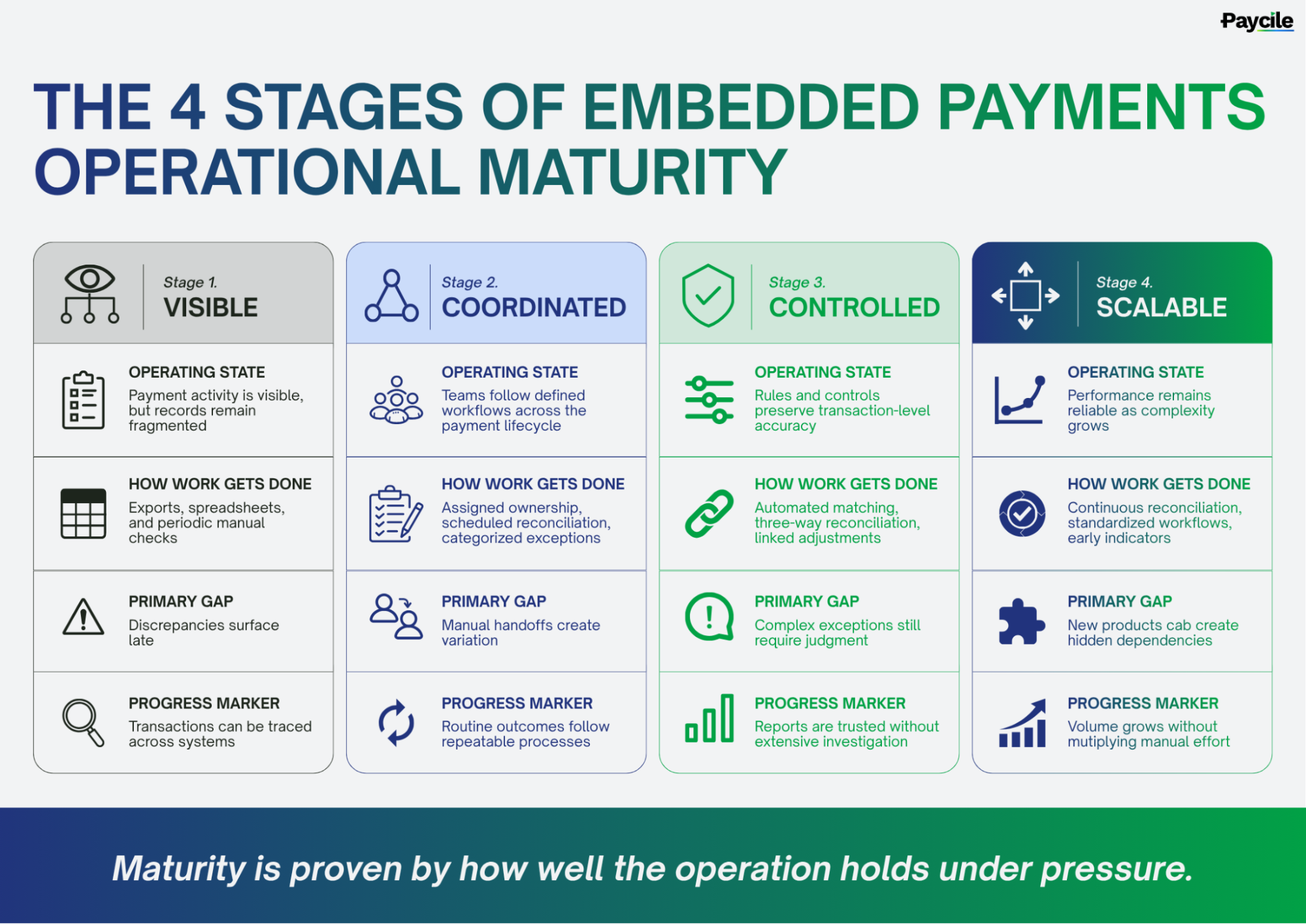
The Four Stages of Embedded Payments Operational Maturity
Industry frameworks evaluate embedded payments maturity through GMV, take rate, team structure, and commercial progression.
Paycile’s operational view adds another dimension. It evaluates whether the financial workflows behind the program can support its current complexity and next stage of growth.
Stage 1. Visible
At the Visible stage, payment activity can be seen, but the financial picture remains fragmented.
Processor dashboards show transaction status. Bank records confirm deposits. Internal systems record expectations. Finance brings these sources together through exports, spreadsheets, and manual checks.
Reporting emphasizes payment volume and success rates. Questions involving settlement timing, fees, split payouts, or exceptions require additional investigation. Reconciliation may occur only at month-end.
The priority is establishing traceability by identifying every financial data source, the identifiers connecting them, and the points where records diverge.
A platform can move beyond this stage when transactions can be followed across systems, recurring discrepancies are documented, and reconciliation has a clear owner.
Stage 2. Coordinated
At the Coordinated stage, teams follow defined workflows, although manual intervention remains common.
Teams understand their roles. Reconciliation follows a schedule. Exceptions are categorized and routed. Reports use agreed definitions for payment states, settlement periods, fees, and adjustments.
The operation becomes repeatable, although people may still transfer data or update several systems. One return can require finance to change a balance, operations to adjust a payout, and support to notify the customer separately.
The priority is reducing variation. Similar events should trigger similar actions, regardless of which employee receives the case or when it occurs.
Progress appears when routine transactions follow consistent workflows and reporting no longer depends on one person reconstructing the month.
Stage 3. Controlled
At the Controlled stage, payment workflows operate through established rules, financial controls, and audit trails.
The platform uses three-way reconciliation to align internal records, processor activity, and bank settlements at the transaction level. Allocation rules are applied consistently. Exceptions trigger defined downstream actions and reach the correct owner.
Automation handles routine matching so teams can focus on discrepancies requiring judgment. Adjustments remain linked to the original transaction, affected balances, settlement activity, and resolution.
Payment ecosystems will always produce timing differences, reversals, disputes, and incomplete information.
A controlled operation recognizes these outcomes, routes them predictably, and explains their financial impact. It no longer requires extensive investigations before reports can be trusted.
Stage 4. Scalable
At the Scalable stage, operational performance remains reliable as volume, products, entities, and payment complexity increase.
Reconciliation runs continuously or at appropriate intervals. Manual effort does not rise with transaction volume. New payment methods connect to established workflows, while multi-party allocations, trust-account activity, and payouts remain traceable.
Leaders can monitor exception rates, resolution time, reporting latency, and unmatched transactions before they affect close timelines or customer experience.
This adaptability matters as vertical SaaS platforms expand. More than half of relevant North American ISVs offered embedded payments in 2025, while significant opportunity remained in broader financial services.
Every added capability places more weight on the systems connecting transaction data, ownership, and reporting.
A scalable operation can carry that additional weight without losing control over the activity already in motion.

What Changes as Embedded Payments Mature?
The movement through these stages is visible across several operational capabilities.
Visibility Becomes Traceability
A dashboard can confirm that a payment succeeded. Traceability explains how that payment moved through authorization, fees, settlement, allocation, payout, and reporting.
This record becomes essential when the sequence changes. A refund may settle separately, a return may affect a future payout, and a fee adjustment may change the economics without changing the visible transaction amount.
Mature operations preserve the connections between these events.
Reconciliation Moves Closer to the Transaction
Periodic reconciliation allows discrepancies to accumulate. Mature programs compare records as data becomes available, while supporting information is still current.
Automation becomes increasingly valuable when reconciliation delays close, exception investigations consume finance capacity, multiple entities create additional record sets, or reports cannot be reproduced without manual work.
Exceptions Become Part of the Operating Model
Returns, refunds, chargebacks, reversals, and failed payouts should have defined financial consequences.
For each event, the operation needs to know who owns the response, which records and funds are affected, what must be communicated, and how the resolution will be documented.
Ownership Becomes Explicit
Payments touch product, engineering, finance, operations, support, risk, and compliance. Mature organizations define ownership at the decision level.
Finance may own the accounting treatment. Operations may manage the workflow. Support may communicate with the customer. Product and engineering may own the system behavior.
Clear boundaries prevent important actions from disappearing between departments.
Reporting Becomes Operational Evidence
Reliable reporting explains what happened, when it happened, which systems recorded it, how funds were allocated, and whether the final records reconcile.
This changes reporting from a summary of activity into evidence that the payment operation remains under control.

How to Assess Your Embedded Payments Maturity
An embedded payments maturity assessment should show where the current operation remains dependable and where additional complexity could place it under strain.
The following process turns that assessment into a practical review.
- Select a Transaction That Tested the Process
Choose one transaction that did not follow the expected path.
A refund, return, chargeback, partial settlement, or payout adjustment will reveal more than a successful payment because it tests how the operation responds to change.
- Trace the Complete Transaction Lifecycle
Follow the transaction through every system and financial record it affected:
- The platform record
- Processor data
- Bank settlement
- Customer or merchant balances
- Allocations and payouts
- Financial reporting
- The final resolution record
The goal is to confirm that the same event remains connected and explainable from initiation through its final financial outcome.
- Identify Where the Explanation Breaks
Document every point where the investigation requires a manual export, private spreadsheet, separate system, or employee with unique knowledge.
These dependencies reveal traceability and coordination gaps. They also show which parts of the process may become unreliable as transaction volume, team size, or payment complexity increases.
- Review the Program Across Six Dimensions
Use the transaction review as a starting point, then evaluate the wider payment program.
- Visibility. Can every transaction be followed from initiation to final outcome?
- Reconciliation. Do internal, processor, and bank records remain aligned?
- Exceptions. Do non-standard outcomes follow defined workflows?
- Ownership. Does each operational decision have a clear owner?
- Reporting. Can reported totals be traced back to transaction-level evidence?
- Scalability. Would the same processes remain reliable if volume or complexity doubled?
The answers should reveal whether the platform is operating at the Visible, Coordinated, Controlled, or Scalable stage.
- Track Operational Progress With the Right Metrics
Metrics turn the assessment into a repeatable way to measure improvement.
- Reconciliation completion time. Measures how long the team needs to align payment records for a defined period.
- Automatic match rate. Shows the percentage of transactions reconciled without manual intervention.
- Exception volume. Tracks how many transactions require investigation or a non-standard response.
- Average exception resolution time. Measures how quickly identified payment issues reach a documented outcome.
- Unresolved transaction count. Shows how many payment events remain open, unmatched, or unexplained.
- Manual hours per reporting period. Captures the operational effort required to produce reliable financial records.
- Payment-related close adjustments. Tracks corrections discovered while preparing period-end financial reports.
- Reporting latency. Measures the time between payment activity and the availability of complete, reliable reporting.
- Audit or control findings. Identifies recurring weaknesses in payment records, processes, ownership, or documentation.
- Support cases per transaction. Shows whether payment-related customer questions are increasing faster than payment activity.
These metrics should be reviewed together. A faster reconciliation process carries limited value if unresolved transactions or reporting adjustments continue to rise.
- Prioritize the Next Operational Capability
Use the assessment to identify the capability that would remove the most significant constraint. Depending on the current stage, that could mean:
- Improving transaction identifiers
- Reconciling more frequently
- Standardizing exception categories
- Assigning clearer operational ownership
- Automating routine transaction matching
- Connecting adjustments to their original transactions
Before changing payment models, document which responsibilities would move to the platform, which teams would own them, how existing systems would support them, and what new risk or compliance obligations would appear.
A commercial model should fit the operation the company is prepared to maintain, not only the economics it wants to capture.
Frequently Asked Questions
Is PayFac the Most Mature Embedded Payments Model?
PayFac represents deeper ownership of the payment value chain, but it does not automatically produce a mature operation. A platform using PFaaS may operate payments more consistently than a registered PayFac with fragmented systems and manual controls. PayFac is also not the required endpoint for every platform.
What Is the Difference Between PFaaS and PayFac?
PFaaS allows a software platform to offer a branded, embedded payment experience while relying on a provider for regulated infrastructure and many underlying responsibilities. A registered PayFac assumes greater direct responsibility for submerchant onboarding, compliance, risk, processing relationships, and oversight. Exact responsibilities vary by agreement.
When Should Payment Reconciliation Be Automated?
Automation becomes important when manual matching delays reporting, consumes significant finance capacity, produces inconsistent results, or cannot keep pace with additional volume, entities, processors, and transaction types.
Does Higher GMV Mean a Payment Program Is Mature?
Higher GMV may justify different economics, infrastructure, or partner arrangements. It does not confirm that transactions are traceable, exceptions are controlled, or financial reports are reliable. Those capabilities must be assessed independently.

The Operation Is the Evidence
Referral, PFaaS, and PayFac models determine how much of the payment experience and infrastructure a platform owns. GMV and take rate show the commercial value that ownership can create.
Neither reveals what happens when a settlement arrives late, a payout changes, or an exception crosses several systems.
That evidence lives in the operation.
Can every transaction be traced to its final outcome? Can every exception reach a documented resolution? Can financial reports remain reliable when volume, products, and entities increase?
Embedded payments maturity is the ability to answer those questions without reconstructing the truth from spreadsheets, disconnected records, or institutional knowledge.
The next stage begins with the operational constraint preventing that answer today.
Scale is proven when the operation can absorb more volume, more exceptions, and more responsibility without losing the truth of a single transaction.
Paycile helps vertical SaaS platforms strengthen the operational layer behind embedded payments through continuous reconciliation, transaction-level visibility, and scalable financial workflows.
Need help assessing your payment operations? Let’s hop on a quick call.